Wednesday, December 30, 2009

Simulation Questions

1) Two accuracies were that the largest countries gained the most land, and that the smaller, weaker countries did not claim much land. This was similar to real imperialism, because the larger countries were more powerful, and therefore they could claim and keep control of new land, while smaller countries were weaker, and could not claim and control much new land.

2) My group only had seven members, so even though we found tons of colonies, only once did we have enough members to actually claim the colony.

3) We were small, so we just stayed together, which is similar to smaller colonies who did not separate from each other.

4) We briefly would pass other colonies, and they always made fun of us because we were so small and we lost, which is similar to real imperialism, where the smaller countries were looked down upon.

5) Overall, I liked the simulation, for it was a fun way of looking at and learning about imperialism. I learned first hand the struggles of having a smaller country, which is what happened in real life.

6) A. Tell students before they choose groups that being in a smaller group automatically means losing.
B. Instead of claiming colonies simply through numbers, we should have to complete a mini task
C. Make more colonies so the simulation last longer.

Saturday, December 19, 2009

Motives For British Imperialism

1) Slavery began to decline in the 1800's because the British realized that it wasn't economically beneficial to them, although they could care less about the moral aspects of the situation. Because of the abolition of slavery, British didn't have to worry about taking or bring slaves from colonized lands, therefore, they could focus entirely on free trade.

2) He said that religion was not an aspect of imperialism, although I disagree, for changing or trying to change ones values and beliefs can strongly affect natives and colonists, and therefore it was a large aspect of imperialism.

3) Halstead believed that trade contributed to imperialism, while Cobden believed that the source of imperialism was the free market. Halstead's theory resembles the mercantilism in many ways.

4) Halstead said that the final motives for imperialism were colonization, competition for free markets and settlements.

Sunday, December 13, 2009

The White Man's Burden

1) Kipling is saying that Imperialism is the white man's burden, for the Europeans considered it their responsibility to help civilize the natives of different lands.

2) To justify imperialism, Kipling says that they are helping the natives, and benefiting their societies.

3) It is appealing, because it makes imperialism seem more noble, instead of simply stating that is a way to make countries more powerful.

4) Religion helped spread Imperialism, because one of the justifications was that they were spreading Christianity to all of the natives.

Tuesday, November 24, 2009

Unit 2 Short Answer Questions

Industrial Revolution
2) Machines had a positive and negative impact on society. They quickly and efficiently created products, allowing mass production, but they created dangerous jobs in the factories, and even got rid of the need for some jobs, despite the growing population.
3) Crop rotation is the use of the same land to grow different crops throughout the different seasons. This practical, efficient use of land allowed for more food to be grown on a smaller space, therefore supporting a larger population quite efficiently.

Social Ramifications
1) With the Industrial Revolution came many new social developments. For example, before, it was common for many generations, or extended families, to live in the same house, but with the revolution, nuclear families became common. Nuclear families only consisted of parents and children.
3) The Factory Acts were reforms that improved working conditions for children during the Revolution. They reduced the workday to a maximum of twelve hours, and made it illegal for children under the age of eight to work in the cotton mills.

Inventors and Inventions
1) Cotton gins are machines that pick and separate cotton. Before the invention of the cotton gin, this was the tedious job of many slaves in the south. Therefore, this new means of production did the job of the slaves, and therefore they could do different jobs.
5) Advancements in medicine contributed to the population growth in many ways. Many people were dying due to the unsanitary, poor living conditions of the city, and many diseases were common. Advancements in medicine were able to combat these diseases, such as cholera, which decreased the death rate due to disease and therefore increased the size of the population.

2nd Industrial Revolution & Mass Society
1) During the nineteenth century, the lower class made up the majority of the population. Politicians realized this, and began to target them, such as in the British Labour Party. Trade Unions also allowed a rise in their power, for they gave the lower classes a voice that they never had before.
2) The original Industrial Revolution and the second Industrial Revolution differed for the original focused more on improvements and technological advancements in agriculture, while the second Industrial Revolution focused on the advancement of technology in every day life, as well as new ideas and theories on society.

Labor Unions
2) The goal of the British Labour Party was to help the general public and to bring trade unions into politics. Their goals included the involvement of government in business, the distribution of wealth and publicly funded healthcare and education policies.
3) The AFL was formed due to the leaders of the trade unions dislike of The Knights of Labor, another large, powerful union of the time. The American Federation of Labor distinguished itself by only allowing workers and organizations of workers to join.

Japanese and Russian Industrialization
3) The Industrialization of Japan required the wars because with Industrialization came expansion. The Japanese needed to grow in power to match their growth in technology and government, thus requiring wars for land.
11) The Industrialization of England occurred first, therefore naturally. The Japanese industrialized quickly and proficiently, while the Russians simply tried to keep up with the rest of the world.

Tuesday, November 10, 2009

1st Person Child Labor Journal Entry

My name is Victoria, I am eleven years old and I work in a large factory in the city. This morning, I ran to the factory a little before sunrise. I was late, and didn't want to be beaten, so I skipped the little amount of breakfast that my mother had left for me and sprinted to the factory so that I would not be beaten by my boss. I was so scared, but somehow I made it. My tummy was growling, but I had to work 5 more hours before I was allowed to take a thirty minute lunch break. While I was working, Edward, the boy who had the machine next to me, came in late. The boss, in his fury, beat Edward with a whip, and although he got hurt really bad, and was crying, Edward had to work the rest of the day, without a lunch break. This made me glad that I was able to run here on time. Finally, lunch came, and I graciously ate my slice of bread and enjoyed the thirty minutes free of labor. All to soon, we were called back in to finish our shifts. The rest of the day seemed to be uneventful, until Emily, a little six year old girl, was killed! Her machine broke down, and the Boss said that she was small enough to crawl inside and fix it. Everything seemed to be fine, until suddenly, an ear shattering scream filled the air. My heart fell, as I realized what I was watching. Emily's leg got caught in the grinder as she was climbing out, and she bled to death. Despite this tragedy, we were forced to continue out our shifts. At dusk, we were released, and I walked home, crying all the way because of the terrible acts that I had witnessed today. As soon as I arrived home, I went to sleep, for I was exhausted and there was no meal for me to eat, anyways. Tomorrow, I will wake up and go through all of this again.

Monday, October 5, 2009

Declaration of the Rights of Man


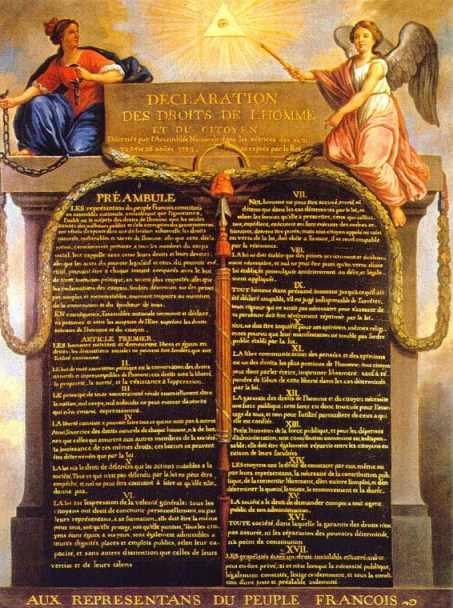
This image of the Declaration of the Rights of Man uses the image of angels and other holy looking symbols to create a positive connotation of its ideas. It reminds me of the Declaration of Independence, and to an extent, it looks a little bit like some pictures of the Biblical Ten Commandments. The creators of this declaration are definitely trying to send out a positive, perfect idea of their declaration to the people of France.


1) All men are born equally, and social classes should only benefit society instead of oppressing the people.

2) The main purpose of a government is to protect the rights of men, not to destroy them.

3) The people have the power in a nation, and one person or group cannot control an entire population.

4) Men have the freedom to do what they want, unless it infringes on another man's natural rights.

5) The law can only be involved with society, and not individuals.

6) Everyone has the right to participate in the law if they choose to, and all are treated equally by the law.

7) People can only be punished by the law, but not in forms not described by the law.

8) The law will only be involved in what is necessary, and not what it is not related too.

9) All men are innocent until proven guilty, and until they are proven, no violence is to be enforced.

10) As long as they don't affect society as a whole, all men are entitled to their own beliefs.

11) All men have the right to the freedom of speech, in all forms.

12) Public security must be used to protect mans rights only, and not for someone's personal gain.

13) A fair an equal tax is necessary to the success of a society.

14) Men have the right to choose the laws and taxes for their society.

15) Society has a right for all men to have identification.

16) If the law is not enforced in society, there is not point in having a legal system at all.

17) Unless there are specific special circumstances, all men have the right to their own property.

Saturday, October 3, 2009

French Revolution Terms

The Estates General~The Estates General was a group of representatives of each class in France. It was comparable to English Parliament, but it had no true power of its own. It met in 1789 to discuss a financial crisis in France. Ultimately, the third estate took control and paved the way for the French Revolution.


1st Estate~The 1st Estate of France was made up of the church clergy members. In France during this time, the Church had much political and social power in society, therefore, members of the clergy were at the top of the social pyramid. Not all clergy members were as well off as the bishops and abbots, though. The 1st Estate had nuns, monks and priests in charge of running schools, hospitals and orphanages.


2nd Estate~The 2nd estate was made up of the nobility. Noble knights lost their military power under Richelieu and Louis XIV, but they were given the right to have top jobs in the government, army, courts and the church. They were landowners, but most did not have much financial income. They tended to hate absolutism, and they feared that they would eventually lose their traditional privileges and soon their status as well.


3rd Estate~The majority of the French population made the up the last, 3rd Estate. Bourgeoisie was at the top of the 3rd estate, and they were the middle class, including bankers, merchants, manufacturers, lawyers, doctors, journalists and professors. The rural peasants made up the majority of the 3rd Estate, and they ranged from prosperous landowners to day laborers. Urban workers also made up this last estate. All members of this Estate resented the 2nd and 1st Estates, especially all of their traditional privileges. The Enlightenment caused the population to question the upper Estates, and demand their fair share of things.


Bourgeoisie~Bourgeoisie, or middle class, were members of the 3rd Estate, but they tended to be wealthy or well off compared to the majority of the population. They included bankers, merchants, manufacturers, lawyers, doctors, journalists and professors. Unlike the upper Estates, members of the Bourgeoisie had to work for their wealth and power, but they were deprived of traditional privileges that the 1st and 2nd Estate members enjoyed.


Declaration of The Rights of Man~The declaration was written by the National Assembly, and it was modeled after the American Declaration of Independence. The Declaration of the Rights of Man says that all man were born and remain free and equal in rights. Men have the natural rights to liberty, property, security, and resistance to oppression. It also said that all Frenchmen had equal rights in law and politics, and it believed in freedom of religion. Women were disappointed when the Declaration did not grant them the same equal rights as men.


Era of Mutual Discontent~Members of the 3rd Estate began to complain of their lack of traditional privileges as well as their natural rights. They became very upset and discontent, causing the 1st and 2nd Estates to also grow upset and discontent, thus leading to the Era of Mutual Discontent.


National Assembly~The National Assembly was a transitional legislative group from Estates-General to the National Constituent Assembly. After the Estates General, the 3rd Estate was unhappy with its lack of power, so its members decided to form their own National Assembly, in which all common class people were able to join. The other Estates were invited, but none joined in the National Assembly's meetings. King Louis was against this new group, but he could not stop them or their force in politics.


Tennis Court Oaths~The delegates of the National Assembly went to Versailles to try and solve the financial crisis as well as to ask for a political reform. Their meeting room was locked and guarded, so they went to an indoor tennis court in fear that the king was upset at them. There, they took an oath, saying that they would never separate and that the would meet whenever they could until their circumstances were met. All but one man signed the oath.


King Louis XVI~King Louis was the king of France from 1754 to 1793. Louis was disliked during his time, for he was conservative in a country of revolutionists. His people blamed him for their problems, although he tried his best to change the monarchy. He had good intentions, but the French public used him as a scapegoat for all of their problems. King Louis was married to Marie Antoinette, and he was often blamed for being a tyrant.


Maximilien Robespierre~Maximilien Robespierre is was an important, well known, influential figure of the French revolution. He was involved in what is known as the Rein of Terror, which ended with his own death. He was influenced by the ideas of the Enlightenment, especially those of Rousseau and Montesqueiu. He believed in a left winged bourgeoisie. He had many supporters who called him the Incorruptible and many opposers who called him the Tyrant.


Reign of Terror~The Reign of Terror was a time period during the French Revolution which went from 1793 until 1794. Symbolized by the guillotine, it is not known how many lost their lives, but many famous deaths include the death of Marie Antoinette and the death of Madame Roland. The Terror was mainly caused by conflict between Girondins and the Jacobins. Finally, the French government stepped forward and ended the reign with the deaths of many powerful supporters of the reign, such as Robespierre and Saint-Just.


Jacobins~The Jacobin Club was the most powerful group during the French Revolution. The club had many chapters throughout France, but after the death of Robespierre, it ended. It became notorious during the Reign of Terror, and they are known to have conflicted with the Girondins.


Committee on Public Safety~The National Convention created the Committee on Public Safety, which is made up of twelve members. It had almost absolute power during the Revolution, and it prepared the country for war. Maximilien Robespierre quickly rose to power in the committee. They sent recruits to spread the revolutionary fever, and soon they had conquered Italy and the Netherlands all while keeping down the revolts in England as well. Soon, members of the Convention turned on the committee, and killed its main players, such as Robespierre, thus ending the Reign of Terror.


Girondins~The Girondins, the enemies of the Jacobins, consisted of the other half of the National Assembly. They were an unorganized bunch, without an extremely organized cause or leader. There political beliefs during the Assembly more closely resembled those of republicans than those of monarchs. They were named after Gironde, whose theories they were modeled after.